

Click on the image to enlarge it
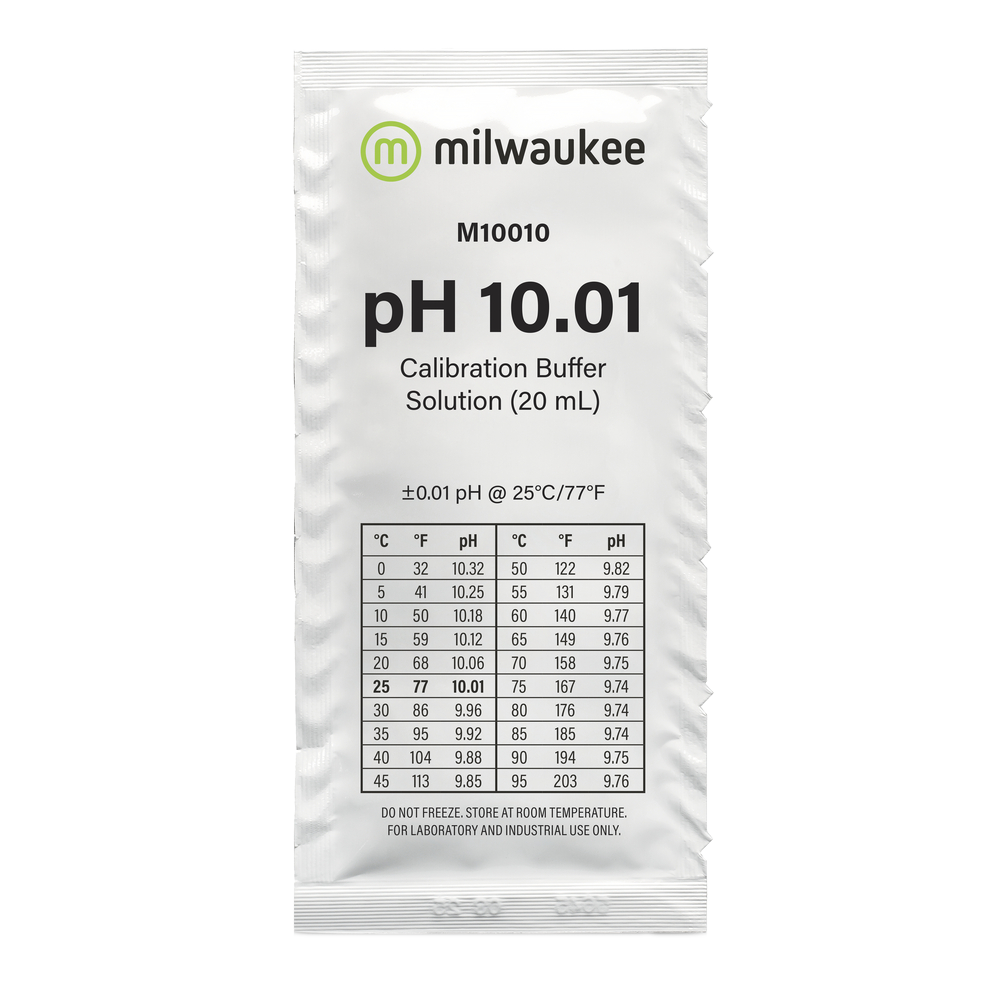
Milwaukee Liquid Calibrator Ph 10.01 Sachet 20ml
Milwaukee Instruments provides you with a wide range of calibration, storage and cleaning fluids.
Liquids are served in 2 formats: 230ml bottle or 20ml sachet.
The use of calibration, cleaning and storage fluids is essential for the proper use of your meters.
In addition to good use, the electrode also benefits by having a longer service life and working more efficiently.
The envelopes are sold individually or per box of 25 units.
To calibrate with the buffer on 20ml pH10.01 calibrator, put the calibration envelope in a beaker (to avoid dropping the envelope and wasting its content). Open the envelope, cutting with the easy-open system or with scissors the upper part of the envelope (1 cm below the stop)
Calibration can be manual or automatic.
In case of manual calibration with the buffer over 20ml pH10.01 calibrator , turn on your meter, put the meter or the electrode inside the envelope, shake lightly to facilitate the meter reading of the buffer, and, with the help of the screwdriver, calibration or the calibration wheel (depending on the model) adjust the data on your screen to the data indicated in the buffer.
In case of automatic calibration with the buffer over 20ml pH10.01 calibrator, follow the instructions in your meter manual. The way to calibrate will depend on each type of meter.
Here are the guidelines for a good maintenance of your measuring equipment.
The case: Are your PH and EC meters malfunctioning, or not working, or slow, or not calibrating?
1st tip : Check batteries - It is very important to have an accurate and fast measurement.
To measure the power of the batteries, use a millimeter in position DCV 20 - A battery that does not have the indicated power will be considered dead, and change.
Example: 1.5V button cell. New, it will have a power of 1.56V, and when it drops from 1.50V, that is to 1.49V, it is dead.
2nd tip : Cleaning the electrode
-
PH : In case your PH meter is slow or does not measure, or does not calibrate, or that the data dances and does not stay fixed. The electrode is most likely dirty. Also, although not generally recommended, light brushing with a soft-haired toothbrush improves the quality of the measurement.
-
After cleaning, your PH meter will also do well to soak for a couple of hours in PH storage liquid (MA9015).
-
A bath in cleaning liquid is recommended (On M10030B or bottle MA9016)
-
EC : In EC, little maintenance is usually given to an electrode. But in the event that your EC measurement does not reach calibration, you can leave the probe in 1 cm of 90║ alcohol for 2 minutes, to dissolve the salts stuck to the irons, which possibly prevent the correct electro conductivity. Storage tips :
-
PH: For a portable PH meter, it is very important to be stored in humidity (put a damp sponge of storage liquid MA9015) - (Never put distilled or deionized water)
-
EC: Store dry, no more.
-
Tips for calibration fluids (buffers):
-
Calibration liquids are normally single use only.
- Especially in conductivity, which are immediately affected by evaporation, which modifies the concentration of salts
- In PH, to calibrate in two points (PH4.01 and PH7.01), try to pass the electrode through tap water when exiting the calibration at pH7.01, so as not to contaminate the PH4.01 buffer. Another thing, the calibration envelopes, after use, can be reused a few times, provided they are closed hermetically (with a seal).
- Avoid falls:
- For EC PH meters, it is advised to avoid drops to the ground, which can definitely damage the LCD screen. For this reason, in Milwaukee, we recommend the use of the carrying case (ask us!)
- Also, to avoid falls into the water, it is advisable to measure from a glass. In addition to ensuring that your meter does not fall into water, it will also give your meter time to stabilize and thus give a more accurate measurement.